

Daily Equipment Inspection: What to Check and Who Does It
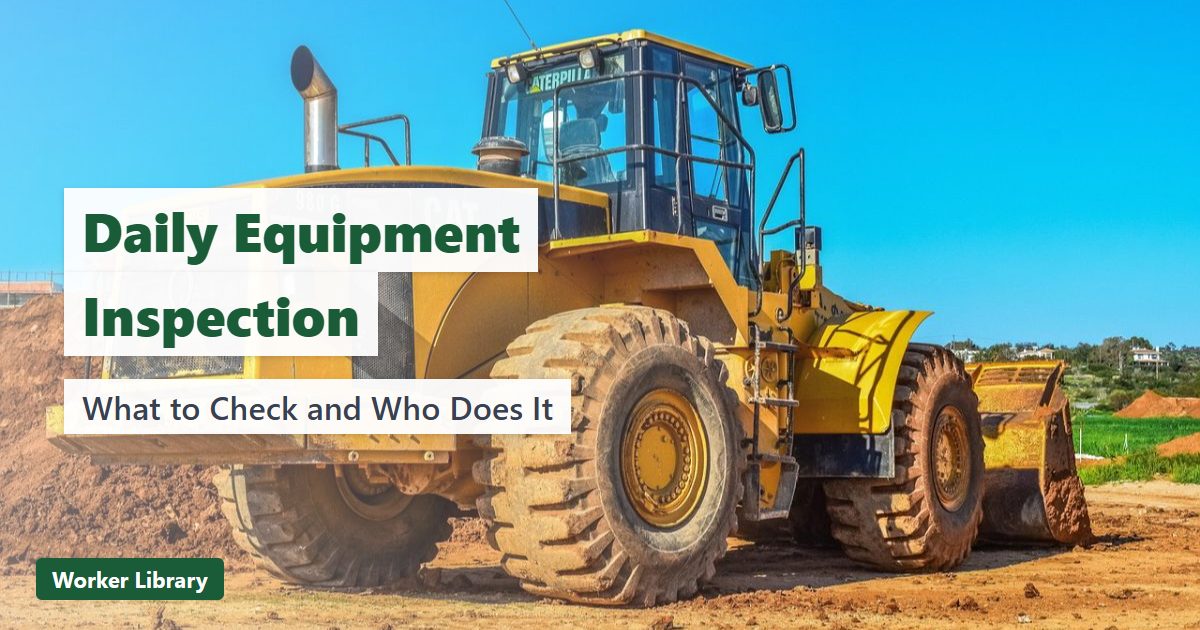
A daily equipment inspection is the few minutes an operator spends looking over a machine before the shift starts. This guide covers what to check, who should do it, how to handle a defect, and how to keep a month of checks on one sheet.
- A daily equipment inspection is a short operator check at the start of each shift, done without tools or opening guards.
- No single federal rule covers all machines, but forklifts, aerial lifts, cranes, slings, and scaffolds have their own.
- A machine stopped for a defect goes back into service only after someone has checked the repair.
- For general machines no federal rule sets a form or retention period; many companies keep a year.
Free daily equipment inspection checklist in Excel: 18 checks in 5 groups, a 31-day grid for one machine per month, a defect record, and a print sheet.
A daily equipment inspection is a short check of a machine at the start of each shift, done to catch leaks, damage, missing guards, and failed safety devices before anyone runs it. It is not a repair job and not a full maintenance round. Its value is that it happens every day, so a problem that started overnight is found before it hurts someone or stops production.
What a daily equipment inspection includes
A daily equipment inspection includes the things an operator can see, hear, smell, and test without tools or opening guards. That usually means:
- The outside of the machine and its guards
- How it sounds and runs when started
- Leaks and fluid levels
- The emergency stop and interlocks
- Wiring and cables
- The area around the machine
Slower changes, such as belt tension, bearing wear, and filter condition, are better on a monthly preventive maintenance checklist done by maintenance. Keeping the daily list to fast checks is what makes it get done every day.
Is a daily equipment inspection required by OSHA?
A daily equipment inspection is not required by one federal rule that covers all machines. For most production equipment (presses, mills, conveyors, mixers, packaging lines), the daily check comes from the manufacturer's manual and company policy.
Some equipment does have its own rule that asks for a check before use or each day. Examples:
| Equipment | Rule | What it asks for |
|---|---|---|
| Forklifts and other powered industrial trucks | 29 CFR 1910.178(q)(7) | Examine before placing in service; at least daily, or after each shift if used around the clock |
| Aerial lifts (boom type) | 29 CFR 1910.67(c)(2)(i), 29 CFR 1926.453(b)(2)(i) | Test lift controls each day prior to use |
| Cranes in construction | 29 CFR 1926.1412(d)(1) | Competent person begins a visual inspection prior to each shift |
| Slings | 29 CFR 1910.184(d) | Inspect each day before use, by a competent person |
| Scaffolds in construction | 29 CFR 1926.451(f)(3) | Competent person inspects before each work shift |
| Commercial motor vehicles | 49 CFR 396.11(a) | Driver prepares a written inspection report at the end of each day's work (with some exceptions) |
If a machine is on this list, use a checklist made for it, such as the forklift inspection checklist or the crane inspection checklist, and check the current rule. For everything else, a general daily sheet works. State plans such as Cal/OSHA may add requirements of their own.
What to check in a daily equipment inspection
A daily equipment inspection on a typical production machine fits in five groups. The template lists 18 checks; most machines need between 10 and 20.
| Group | Checks |
|---|---|
| Exterior and structure | No damage, deformation, or rust; safety guards and fences in place and secure; nameplate and warning labels legible |
| Operating condition | No abnormal noise or vibration; no unusual smell or smoke; gauges in the normal range; starts and stops smoothly |
| Hydraulics, pneumatics, lubrication | No oil or air leaks; oil level within the marked range; lubrication points greased or oiled |
| Electrical and safety devices | Emergency stop works; interlocks work; no damaged wiring or cables; ground wire connected; lockout/tagout disconnect accessible and labeled |
| Surroundings | Area clean of chips, oil, and debris; aisles and emergency exits clear; tools and fixtures returned |
Adjust the list for each machine:
- Add checks from the manual's daily section, such as an air pressure reading or a light curtain test.
- Remove lines that do not apply. A machine with no hydraulics does not need an oil level line.
- Use readings instead of checkmarks for anything with a number, such as pressure or temperature.
Who does the daily equipment inspection
A daily equipment inspection is usually done by the operator who will run the machine on that shift. The operator knows how it normally sounds and feels, and is the person most at risk if something is wrong.
Three roles keep it working:
- Operator. Does the check, marks the sheet, and reports any defect right away.
- Supervisor or shift lead. Decides whether the machine keeps running or stops when a defect is found, and reviews the sheet weekly.
- Maintenance. Fixes what is found and signs off the repair before the machine returns to service.
Decide ahead of time who can stop a machine. If the operator has to find a manager before stopping a leaking press, the check loses its point. Where a specific rule names a competent person, as the sling and construction crane rules do, that person does the inspection.
Free daily equipment inspection checklist in Excel: 18 checks in 5 groups, a 31-day grid for one machine per month, a defect record, and a print sheet.
How to run a daily equipment inspection
A daily equipment inspection works best as a fixed routine done in the same order every time. One way to run it:
- Before starting. Walk around the machine. Look for damage, missing guards, leaks on the floor, and loose cables. Check fluid levels at the sight glass.
- Start it up. Listen for new noises, watch the gauges, and note any smell or smoke.
- Test the safety devices. Press the emergency stop and confirm the machine stops. Open a guard with an interlock and confirm it stops or will not start.
- Check the area. Aisles and exits clear, no chips or oil on the floor, tools put away.
- Mark the sheet. One mark per check for today's date.
- Report anything wrong before running production.
Do not reach into a machine or open a fixed guard as part of the daily check. If a check needs that, it belongs in a maintenance task with lockout/tagout.
What to do when a daily equipment inspection finds a problem
A daily equipment inspection finds problems only if someone acts on them. For each defect:
- Mark it on the sheet.
- Decide: stop the machine, or keep running after a quick fix (for example, cleaning up chips).
- Tell the supervisor or maintenance, and write down who you told and when.
- Write what was done and who did it.
- If the machine was stopped, it goes back into service only after someone has checked the repair.
For forklifts, the rule is clear: a truck with a condition that adversely affects safety is not placed in service (29 CFR 1910.178(q)(7)). Many companies apply the same rule to all machines on their daily list.
How to record daily equipment inspections
A daily equipment inspection record is the only way to show later that the checks happened and what was found. For general machines, no federal rule sets a form or a retention period, so the format is up to you.
The free daily equipment inspection checklist puts one machine and one month on one sheet:
- A header for equipment name, equipment ID, location, and month
- 18 checks in five groups down the side and days 1 to 31 across the top
- A drop-down for ✓ (OK), X (defect), or N/A in each cell
- Initials rows for the inspector and the reviewer
- A defect record below the grid: what was found, what was done, who was told, and who returned the machine to service
- A print sheet for US Letter
Many plants print the sheet, keep it on a clipboard at the machine, and file it at the end of the month. Seeing a whole month at once also shows patterns, such as a leak that comes back every few days.
Free daily equipment inspection checklist in Excel: 18 checks in 5 groups, a 31-day grid for one machine per month, a defect record, and a print sheet.
How to keep daily equipment inspections from becoming a checkbox
A daily equipment inspection loses its value when people fill in a column of checkmarks without looking. Signs this is happening: no X marks for months, the same handwriting for every shift, or checks filled in for days the machine did not run.
What helps:
- Cut the list. Five checks done honestly are worth more than twenty skipped. Move slow items to the monthly PM.
- Review the sheets. A supervisor who reads the sheet each week and asks about an X shows the check matters.
- Close the loop. When an operator reports a defect, fix it or explain the plan. If reports go nowhere, they stop.
- Walk it together. Have a supervisor do the check with a new operator the first few times.
Daily equipment inspection FAQ
What is the difference between a daily inspection and preventive maintenance?
The daily inspection is a quick check by the operator before running the machine. Preventive maintenance is scheduled work by maintenance (lubrication, adjustments, part replacement) done monthly or by run hours. The daily check finds problems; PM prevents them.
How long should a daily equipment inspection take?
Long enough to do every check on the list. If it takes so long that operators skip it, the list is too long. Trim it to the checks that have found real problems or that protect people.
Should the daily check be done at the start or end of the shift?
Most sites do it at the start, because the goal is to find problems before the machine runs. Some add a short end-of-shift check so the next shift gets a clean machine. The forklift rule asks for the examination before the truck is placed in service.
How long should daily inspection records be kept?
Unless a rule for that equipment says otherwise, it is up to company policy. Many companies keep a year so they can look back at repeat defects. Keep the defect records with the machine's maintenance history.
Can one checklist cover several machines?
Use one sheet per machine. Combining machines on one sheet makes it hard to see which one has the defect and hard to track history. Copy the template once for each machine and adjust the checks.
Free daily equipment inspection checklist in Excel: 18 checks in 5 groups, a 31-day grid for one machine per month, a defect record, and a print sheet.
Related guides

More in Equipment & Maintenance
Popular templates
- Forklift Inspection ChecklistForklifts & Vehicles
- Preventive Maintenance ChecklistEquipment & Maintenance
- Construction Site Safety ChecklistConstruction Safety
- Scaffold Inspection ChecklistConstruction Safety
- Vehicle Inspection ChecklistForklifts & Vehicles
- Fire Extinguisher Inspection LogWorkplace Safety
- Workplace Safety Inspection ChecklistWorkplace Safety
Categories
Latest guides
- How to Create a Preventive Maintenance Checklist (Free Template)
- OSHA Job Site Inspection Requirements: Who, How Often, Records
- OSHA PPE Inspection Requirements: What the Rules Say and How to Record
- OSHA Power Tool Inspection Requirements on Construction Sites
- OSHA Sling Inspection Requirements: Daily Checks, Who and Records
- Fire Extinguisher Inspection Requirements UK: The Law, Checks and Servicing
- Aerial Lift Inspection Requirements: Daily, Frequent, and Annual
- Harness Inspection Criteria: What to Check and When to Remove
- Ladder Inspection Requirements: OSHA Rules and What to Check
- OSHA Crane Inspection Requirements: Shift, Frequent and Periodic Checks
- Scaffold Inspection Requirements: When, Who, and What to Check
- Forklift LOLER Inspection: Thorough Examination Intervals and Records
- OSHA Forklift Inspection Requirements: Daily Checks and Records
- Fire Extinguisher Inspection Requirements: Monthly and Annual