

Forklift LOLER Inspection: Thorough Examination Intervals and Records
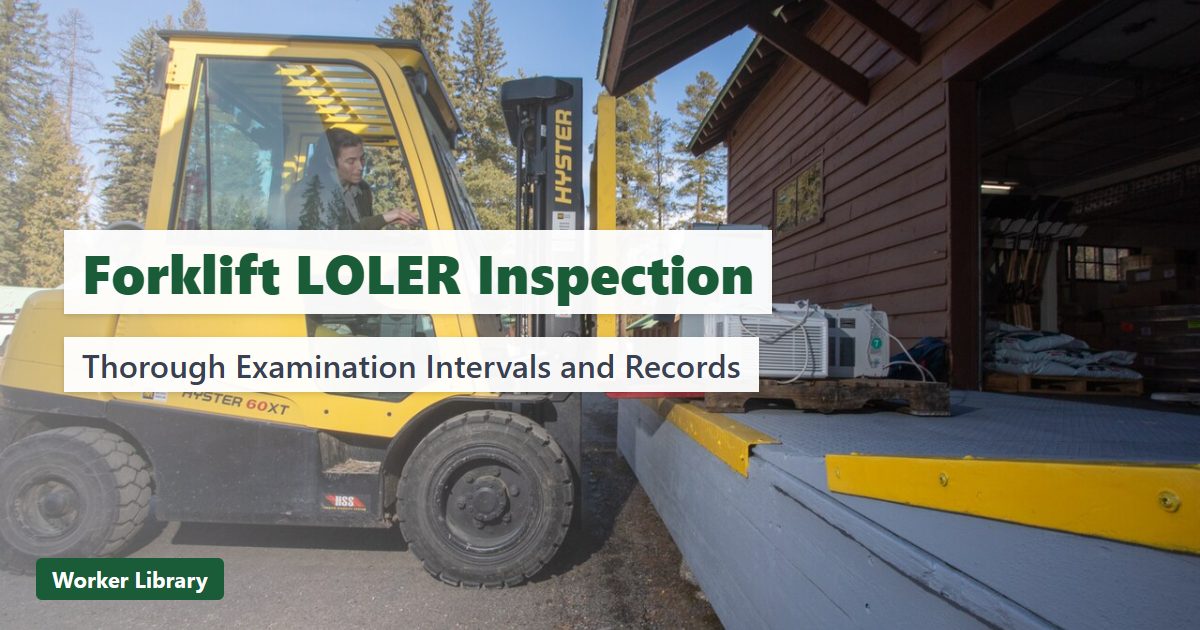
A forklift LOLER inspection is a legal duty for employers in Great Britain who run forklift trucks. This guide sets out what the Lifting Operations and Lifting Equipment Regulations 1998 ask for a forklift, how the rest of the truck is covered, what happens when the examiner finds a defect, and how to keep a record of the checks in between.
- A forklift is lifting equipment, so it needs a thorough examination at least every 12 months, or 6 months if it lifts people.
- An examination scheme drawn up by a competent person can set different intervals.
- After a dangerous defect is reported, the truck must not be used until the defect is put right.
- Keep each periodic report until the next one is made or for two years, whichever is later.
Free forklift inspection checklist in Excel: a daily pre-shift sheet for operators, a 38-item monthly inspection, and an annual service record.
A forklift LOLER inspection is the thorough examination that the Lifting Operations and Lifting Equipment Regulations 1998 (LOLER) require for a forklift truck, because the truck lifts and lowers loads. People search for a "LOLER certificate" or a "forklift thorough examination", and both mean the same thing: a competent person examines the truck at set times and writes a report. This guide covers when that is due, how the rest of the truck is kept safe, what happens when a defect is found, and how to record the checks your own people make between examinations.
These rules apply in Great Britain (England, Scotland and Wales). Northern Ireland has its own regulations with similar content. This is general information, not legal advice.
Why a forklift LOLER inspection is a legal duty
A forklift LOLER inspection is required because LOLER defines lifting equipment as work equipment for lifting or lowering loads, including its attachments used for anchoring, fixing or supporting it. A forklift truck lifts and lowers loads, so its mast, carriage, forks and lifting chains are lifting equipment under LOLER. A "load" includes a person, which matters if the truck is ever used with a working platform.
The general duty sits behind the regulations. Under the Health and Safety at Work etc. Act 1974, section 2, every employer must, so far as is reasonably practicable, provide and maintain plant that is safe. LOLER spells out how that duty works for lifting, and the core of it is regulation 9.
The duty in regulation 9 falls on the employer. If you hire a truck, the hire company will normally arrange the examination, but you still need to see evidence that it has been done before you use it.
Forklift LOLER inspection intervals
The forklift LOLER inspection interval comes from regulation 9(3). It applies to lifting equipment exposed to conditions causing deterioration liable to result in dangerous situations, which describes almost every forklift in daily use. A forklift needs a thorough examination at least every 12 months, or at least every 6 months if it is used to lift people, unless an examination scheme sets other intervals.
| What | Interval | Who | Record |
|---|---|---|---|
| Thorough examination, truck lifting goods only | At least every 12 months, or per an examination scheme (reg. 9(3)) | Competent person | Written report (reg. 10) |
| Thorough examination, truck used to lift people | At least every 6 months, or per an examination scheme (reg. 9(3)) | Competent person | Written report (reg. 10) |
| Accessories for lifting used with the truck | At least every 6 months, or per an examination scheme (reg. 9(3)) | Competent person | Written report (reg. 10) |
| After exceptional circumstances (overturn, overload, impact) | Each time they occur (reg. 9(3)(a)(iv)) | Competent person | Written report (reg. 10) |
| Inspection between examinations | At suitable intervals, if appropriate (reg. 9(3)(b)) | Competent person | Written record (reg. 10(2)) |
| Operator pre-use check | Each shift (common practice, not a fixed rule) | Trained operator | Daily checklist |
An examination scheme is a suitable scheme drawn up by a competent person, setting thorough examinations at intervals appropriate to the equipment. A truck working three shifts in a cold store may need examining more often than one used for an hour a day, and a scheme lets the examiner set that.
Attachments need a moment of thought. LOLER defines an accessory for lifting as lifting equipment for attaching loads to machinery for lifting. Slings, shackles and hooks used under the forks fall into that group and take the 6 month interval. Whether a particular clamp, rotator or jib counts as part of the truck or as an accessory is a question to settle with your examiner and write down.
Forklift LOLER inspection before first use and for hired trucks
A forklift LOLER inspection is also due before a truck is first put into service by you. Under regulation 9(1), lifting equipment is thoroughly examined for any defect before first use, unless it has not been used before and comes with a declaration of conformity made not more than 12 months before it goes into service. A new truck from the dealer with its paperwork is usually in that position; a second-hand truck is not.
Hired and borrowed trucks are covered by regulation 9(4). Lifting equipment obtained from another business must not be used unless it is accompanied by physical evidence that the last thorough examination was carried out. The same rule works the other way: a truck that leaves your business, for example on loan to another site run by a different company, goes with that evidence.
In practice:
- Ask the hire company for a copy of the current report before the truck is delivered.
- Check that the truck's serial number on the report matches the data plate.
- Note the date the next examination is due, and who will arrange it if the hire runs past that date.
Who carries out a forklift LOLER inspection
A forklift LOLER inspection is made by a competent person. LOLER defines a thorough examination as an examination by a competent person, including testing where that is appropriate for the purpose. The regulations do not name a qualification, so the employer chooses someone with the knowledge and experience to find defects in that type of truck and judge how serious they are.
Common practice on British sites:
- Thorough examinations are usually done by an engineering surveyor from an insurer, an independent inspection body, or a forklift service company with trained examiners.
- Inspections between examinations are often done in-house by a trained maintenance person or supervisor.
- Pre-use checks are done by the operator at the start of the shift.
Many employers prefer the examiner to be independent of the people who service the truck, so the judgement is not made under pressure to keep the truck running. The regulations leave that choice to you.
Forklift LOLER inspection and the rest of the truck
A forklift LOLER inspection covers the lifting side. A forklift is also work equipment, and the Provision and Use of Work Equipment Regulations 1998 (PUWER), regulation 5, requires work equipment to be maintained in an efficient state, in efficient working order and in good repair. Brakes, steering, tyres, lights and the horn are covered by that maintenance duty, even though LOLER is about lifting. Where the truck has a maintenance log, regulation 5(2) says the log is kept up to date.
The inspection rule in PUWER regulation 6 does not apply to work equipment for lifting loads, including persons. So the inspection duties for a forklift come from LOLER, and the upkeep duty comes from PUWER regulation 5. Many examiners check the truck's brakes, steering and other safety parts during the same visit, as common practice; ask what your examiner's report covers so there is no gap.
The operator's pre-use check is not set by either regulation as a fixed daily task. It is common practice, and it is how most employers show that defects are found and reported between visits. Use your risk assessment under regulation 3 of the Management of Health and Safety at Work Regulations 1999 to decide what operators check and how often.
Free forklift inspection checklist in Excel: a daily pre-shift sheet for operators, a 38-item monthly inspection, and an annual service record.
When a forklift LOLER inspection finds a defect
A forklift LOLER inspection that finds a dangerous defect triggers regulation 10. The examiner must notify the employer forthwith of any defect that is or could become a danger to persons, then make a written, authenticated report as soon as practicable to the employer and to anyone the truck was hired or leased from. Once notified, the employer must make sure the truck is not used before the defect is put right.
Some defects are not dangerous yet but will become so, for example chain wear approaching its limit. The report can give a time by which such a defect must be fixed, and after that time the truck must not be used until it is rectified.
Where the examiner finds a defect involving an existing or imminent risk of serious personal injury, they must also send a copy of the report to the relevant enforcing authority. For hired or leased equipment that is the Health and Safety Executive; otherwise it is the enforcing authority for the premises where the examination took place.
What a sensible process looks like on site:
- Take the truck out of use and tag it.
- Record the defect, who was told and when.
- Arrange the repair, and write down who did it and when.
- Return the truck to use only once the defect is rectified, and keep the evidence with the report.
Forklift LOLER inspection records
Forklift LOLER inspection records are set out in regulation 11. Reports of periodic thorough examinations are kept available for inspection until the next report is made, or for two years, whichever is later.
The other items to keep:
- Declaration of conformity received with a new truck: kept for as long as you operate the truck.
- Report of the first examination under regulation 9(1): kept until you stop using the truck.
- Records of inspections between examinations (regulation 10(2)): kept until the next record is made.
The report must contain the information in Schedule 1 to LOLER; check the current schedule at legislation.gov.uk if you are reviewing a report's content. Keep the latest report for each truck where it can be found quickly, cross-referenced by truck ID or serial number.
Keeping forklift checks with the template
Forklift LOLER inspection paperwork is easier to manage when each truck has one file. The Forklift Inspection Checklist keeps the checks for one truck in one Excel file. It is a way to record the day-to-day and monthly checks your people make. It is not a report of thorough examination; that report comes from the competent person who examines the truck.
What the file holds:
- Daily Pre-Shift: 10 visual checks with the key off and 6 operational checks with the truck running, with a column for each day of the month, operator initials and the hour meter reading
- A defect record: what was found, whether the truck was stopped, who was told, the repair, and who returned it to service
- Monthly Inspection: 38 components in 8 systems, including forks, mast, lift chains, hydraulics, brakes and steering, with what to check and how
- Annual Service Record: date, company, hour meter, result, defects, repairs, repair date and next due date
For a British site, use the Annual Service Record as a log of thorough examinations: one line per examination, with the examiner's company, the result, and the date the next one is due. Keep the examiner's report itself alongside the file. The template was built with US defaults, so change the sample capacity from pounds to kilograms and set dates to day/month/year if you prefer. For slings and shackles used with the truck, the Rigging Inspection Checklist gives each accessory its own line, and the equipment maintenance log holds repairs.
Free forklift inspection checklist in Excel: a daily pre-shift sheet for operators, a 38-item monthly inspection, and an annual service record.
Forklift LOLER inspection FAQ
These are the questions about the forklift LOLER inspection that come up most often.
How often does a forklift need a LOLER inspection?
At least every 12 months for a truck that lifts goods only, and at least every 6 months if it is used to lift people, unless an examination scheme drawn up by a competent person sets different intervals. Add an examination after any exceptional circumstances, such as an overturn.
Is a LOLER certificate for a forklift a legal document?
People call it a certificate. LOLER calls it a report of thorough examination, made in writing and authenticated by the examiner. It is the document an inspector or hire company will ask to see.
Does the operator's daily check count as the LOLER inspection?
No. The daily check is common practice and helps catch defects early. The thorough examination is a separate, deeper check by a competent person, and the inspections between examinations are recorded checks by a competent person.
Does a pallet truck need a LOLER thorough examination?
Any work equipment for lifting or lowering loads is lifting equipment under LOLER. Whether a particular hand pallet truck or stacker needs a periodic examination depends on whether it is exposed to deterioration liable to result in dangerous situations. Agree the answer with your examiner and record it.
How does this differ from the wider LOLER rules?
The LOLER inspection requirements guide covers lifting accessories such as slings and shackles. The PUWER inspection requirements guide covers machines that do not lift.
Check the current regulations at the links above and the truck manufacturer's instructions. This guide describes what the regulations ask for; it is not legal advice.
Free forklift inspection checklist in Excel: a daily pre-shift sheet for operators, a 38-item monthly inspection, and an annual service record.
More in Forklifts & Vehicles
Popular templates
- Preventive Maintenance ChecklistEquipment & Maintenance
- Daily Equipment Inspection ChecklistEquipment & Maintenance
- Construction Site Safety ChecklistConstruction Safety
- Scaffold Inspection ChecklistConstruction Safety
- Vehicle Inspection ChecklistForklifts & Vehicles
- Fire Extinguisher Inspection LogWorkplace Safety
- Workplace Safety Inspection ChecklistWorkplace Safety