

Aerial Lift Inspection Requirements: Daily, Frequent, and Annual
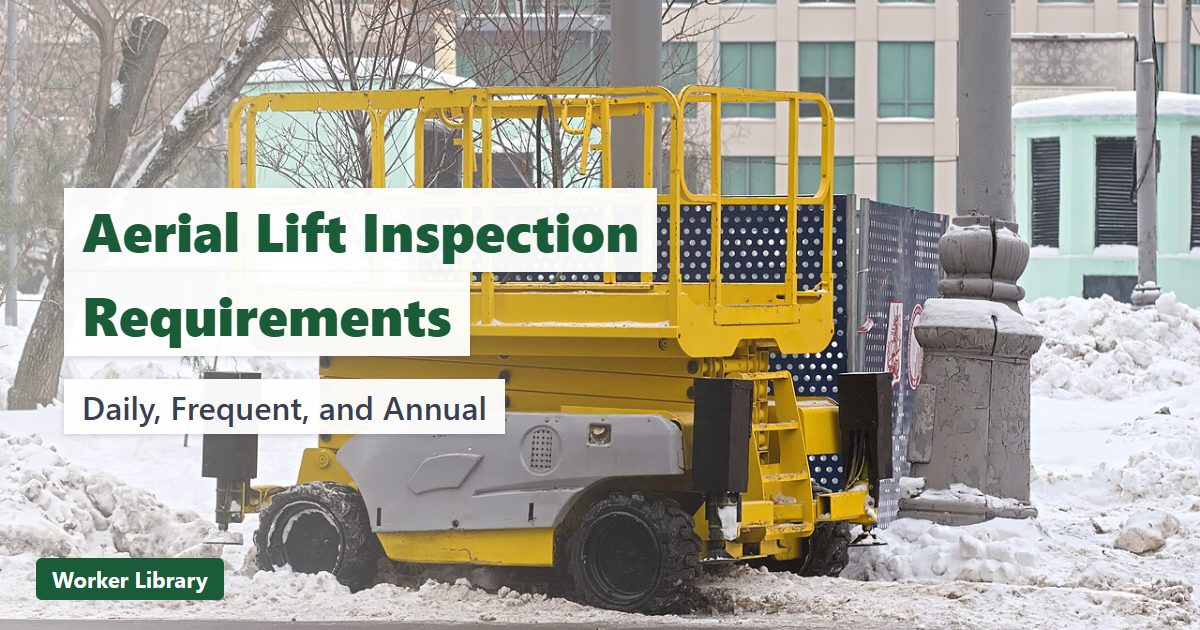
Aerial lift inspection requirements start with one short OSHA sentence about testing the controls each day, then build out with the manufacturer's manual and commonly referenced industry standards. This guide sorts out what is a federal rule, what is common practice, and how to keep the records for each lift.
- OSHA requires aerial lift controls to be tested each day prior to use (29 CFR 1926.453(b)(2)(i) and 29 CFR 1910.67(c)(2)(i)).
- Frequent and annual inspections come from the manufacturer's manual and the commonly referenced ANSI/SAIA A92 series.
- A lift that fails the daily test does not go up; tag it out and record who returned it to service.
- The OSHA rules do not require a written daily record, but most companies keep one for each lift.
Free aerial lift inspection checklist in Excel for boom and scissor lifts: a daily pre-start check, a 34-item monthly inspection, and an annual record.
Aerial lift inspection requirements in OSHA's rules are shorter than most people expect: the lift controls are to be tested each day before use. Everything else you see on a typical inspection program, such as the walk-around, the frequent inspection, and the annual inspection, comes from the manufacturer's manual and from industry standards that many companies follow. Both matter, but it helps to know which is which.
What OSHA's aerial lift inspection requirements say
Aerial lift inspection requirements appear in two nearly identical OSHA rules:
- Construction: 29 CFR 1926.453(b)(2)(i)
- General industry: 29 CFR 1910.67(c)(2)(i)
Both say lift controls shall be tested each day prior to use to determine that they are in safe working condition. Three words carry the weight:
- Controls. The platform controls and the ground controls, including the ability of the ground controls to take over.
- Each day. Once per day the lift is used, before it goes up. A lift that sits unused for a week does not need a test on those days.
- Prior to use. The test comes before the first lift of the day, not at the end of the shift.
OSHA does not publish a monthly or annual aerial lift inspection form, and these two rules do not set a record retention period. The same rules also say only authorized persons operate an aerial lift. State plans such as Cal/OSHA may add requirements, so check the rule that applies where you work.
Which lifts the aerial lift inspection requirements cover
Aerial lift inspection requirements in the two rules above sit under the paragraph for extensible and articulating boom platforms. That covers telescopic boom lifts, articulating boom lifts, and truck-mounted bucket trucks.
Scissor lifts are a different case. OSHA has generally treated scissor lifts as mobile scaffolds rather than aerial lifts. On construction sites that points to the scaffold rule, 29 CFR 1926.451(f)(3), which asks a competent person to inspect scaffolds and components for visible defects before each work shift and after any occurrence that could affect structural integrity. In practice, most companies give scissor lifts the same daily pre-start check as boom lifts, because the manufacturer's manual asks for one either way. If you are not sure which rule your lift falls under, ask OSHA or your state plan.
The three inspection levels used for aerial lifts
Aerial lift inspection requirements, in the way most owners and rental companies run them, have three levels. Only the daily controls test is an OSHA rule. The frequent and annual inspections are commonly referenced in the ANSI/SAIA A92 series and appear in most manufacturers' manuals.
| Level | Who usually does it | When | Source |
|---|---|---|---|
| Daily pre-start | The operator | Each day before use | OSHA rule for the controls test; manual for the rest |
| Frequent (often monthly or quarterly) | Maintenance or a trained mechanic | Set by the manual, often by months or hours of use | Manufacturer's manual; ANSI/SAIA A92 commonly referenced |
| Annual | A qualified mechanic, dealer, or service company | Once a year | Manufacturer's manual; ANSI/SAIA A92 commonly referenced |
Many manuals set the frequent inspection at around every 3 months or 150 hours of use, whichever comes first, and also before a lift returns to service after sitting for a long time. Your manual is the authority for your model, so check the interval there. Some companies add a monthly inspection on top, especially for lifts that run every day.
What the daily pre-start inspection covers
Aerial lift inspection requirements for the daily check begin with the OSHA controls test, and the manual usually adds a walk-around and a look at the work area.
Function tests (the OSHA part):
- Drive brake and parking brake stop and hold the machine.
- Platform and ground controls work and return to neutral when released.
- Ground controls override the platform controls.
- Boom and platform raise, lower, extend, and rotate smoothly.
- Emergency stop and emergency (manual) lowering work.
- Tilt alarm, motion alarm, and horn work.
Walk-around:
- Guardrails, midrails, toeboards, and the entry gate or chain are in place and latch
- Fall protection anchor points are not bent or damaged
- Tires and wheels: damage, pressure, loose lug nuts
- Outriggers or stabilizers extend and retract (if equipped)
- No hydraulic leaks, damaged hoses, or loose or missing parts
- Decals, capacity plate, and the operator's manual are on the machine
- Battery charge or fuel level
Work area:
- Overhead power lines and other overhead obstructions
- Slopes, holes, drop-offs, and soft ground
- Traffic and pedestrians near the lift
The work area check is the one most often skipped, and power lines are a serious hazard on boom lifts. Write it into the daily form so it gets done.
Free aerial lift inspection checklist in Excel for boom and scissor lifts: a daily pre-start check, a 34-item monthly inspection, and an annual record.
Monthly and frequent aerial lift inspections
Aerial lift inspection requirements beyond the daily check are mostly set by the manufacturer, not by OSHA. The frequent or monthly inspection goes deeper than the walk-around and is done by maintenance or another trained person. Typical systems:
| System | Example components |
|---|---|
| Engine and chassis | Engine or drive motor, cooling system, battery and wiring, tires or tracks |
| Brakes and controls | Drive and parking brakes, drive controls, platform control box, ground station |
| Boom and hydraulics | Boom structure and welds, extension chains or wire ropes, turntable, platform, leveling, cylinders, hoses |
| Safety devices | Load limit device, tilt sensor and envelope limit, outrigger interlock, emergency stop and lowering, anchor points |
| Body and other | Lights and alarms, gauges, decals, lubrication points |
Each line should say what to check and how, such as "Boom extension chains: stretch, broken links, lubrication, even tension left to right; visual." That way two inspectors reach the same result.
The annual aerial lift inspection
Aerial lift inspection requirements for an annual inspection come from the manufacturer's manual and the commonly referenced ANSI/SAIA A92 series, not from the OSHA rules above. The annual inspection is a full mechanical and operational check of the lift, usually done by a qualified mechanic, the dealer, or a service company that knows the make and model.
What to ask for and keep:
- The inspection date and the hour meter reading
- The name of the inspector and company
- Pass or fail, and every defect found
- Repairs made and the repair date
- The next annual inspection due date
Keep the inspector's report with the lift's file. When you sell or return a lift, that history is what the next owner asks for.
What to do when an aerial lift fails an inspection
Aerial lift inspection requirements say the controls must be in safe working condition before use, so a lift that fails the daily test does not go up. The usual steps:
- Stop. Do not use the lift, even for a quick job.
- Tag the lift out at the controls so the next person sees it.
- Tell the supervisor and, for a rental, the rental company.
- Write down what was found, who was told, and when.
- Have the repair done by someone qualified on that lift.
- Test the function again before returning the lift to service, and record who returned it.
How to record aerial lift inspections
Aerial lift inspection requirements in the OSHA rules call for the daily test but not for a written record. Most companies keep one anyway, because it is the only way to show the test was done and because rental companies, insurers, and general contractors often ask for it.
The free aerial lift inspection checklist keeps the three levels for one lift in one Excel file:
- Daily Pre-Start sheet. 5 function tests and 8 walk-around checks down the side, days of the month across the top, with operator initials and the hour meter each day. A defect record below the grid shows what was found, whether the lift was stopped, who was told, the repair, and who returned it to service.
- Monthly Inspection sheet. 34 components in 6 systems, each with what to check and the method, plus sign-off lines for the inspector, maintenance lead, and manager.
- Annual Inspection Record. One line per annual inspection with date, inspector or company, hour meter, result, defects, repairs, and next due date.
For scissor lifts, mark boom-only items such as the turntable and extension chains N/A. Use one file per lift so the history stays together. If the same crew also uses ladders or harnesses, the ladder inspection checklist and harness inspection checklist follow the same layout.
Free aerial lift inspection checklist in Excel for boom and scissor lifts: a daily pre-start check, a 34-item monthly inspection, and an annual record.
Inspecting rented aerial lifts
Aerial lift inspection requirements apply to the lift in use, whether you own it or rent it. The daily controls test is done by the people using the lift. The rental company usually handles the frequent and annual inspections on its own fleet.
On delivery:
- Ask for the latest annual inspection record and check the date
- Check that the operator's manual and capacity plate are on the machine
- Do a full pre-start check before signing the delivery ticket, and note any damage
On long rentals, agree in writing who does the frequent inspection when it comes due, and keep a copy of their record in your file.
Aerial lift inspection requirements FAQ
Does OSHA require a daily aerial lift inspection?
OSHA requires that lift controls be tested each day prior to use (29 CFR 1926.453(b)(2)(i) for construction and 29 CFR 1910.67(c)(2)(i) for general industry). A full daily walk-around is what most manufacturers' manuals ask for on top of that.
Who is allowed to inspect an aerial lift?
The operator does the daily pre-start check. Frequent and annual inspections are usually done by a mechanic trained on that make and model, the dealer, or a service company. The ANSI/SAIA A92 series is commonly referenced for who may perform them, and your manual will say what it expects.
How often does an aerial lift need an annual inspection?
Once a year, as set out in most manufacturers' manuals and the commonly referenced ANSI/SAIA A92 series. Track the due date on the lift's record so it does not slip.
Do aerial lift inspections need to be documented?
The OSHA rules above do not require a written daily record. Manufacturers and the commonly referenced industry standards usually expect frequent and annual inspections to be recorded, and many companies record the daily check too.
Is a scissor lift inspected the same way as a boom lift?
The daily check is similar: function tests, walk-around, and work area. Boom-only items drop off. OSHA has generally treated scissor lifts as mobile scaffolds, so on construction sites also check the scaffold inspection rule in 29 CFR 1926.451(f)(3).
Free aerial lift inspection checklist in Excel for boom and scissor lifts: a daily pre-start check, a 34-item monthly inspection, and an annual record.
Related guides
 Forklift LOLER Inspection: Thorough Examination Intervals and RecordsForklifts & Vehicles · United Kingdom
 Fire Extinguisher Inspection Requirements: Monthly and AnnualWorkplace Safety
 Scaffold Inspection Requirements: When, Who, and What to CheckConstruction Safety
 OSHA Crane Inspection Requirements: Shift, Frequent and Periodic ChecksConstruction Safety
 Ladder Inspection Requirements: OSHA Rules and What to CheckConstruction Safety
More in Forklifts & Vehicles
Popular templates
- Forklift Inspection ChecklistForklifts & Vehicles
- Preventive Maintenance ChecklistEquipment & Maintenance
- Daily Equipment Inspection ChecklistEquipment & Maintenance
- Construction Site Safety ChecklistConstruction Safety
- Scaffold Inspection ChecklistConstruction Safety
- Vehicle Inspection ChecklistForklifts & Vehicles
- Fire Extinguisher Inspection LogWorkplace Safety
Categories
Latest guides
- Harness Inspection Criteria: What to Check and When to Remove
- Ladder Inspection Requirements: OSHA Rules and What to Check
- OSHA Crane Inspection Requirements: Shift, Frequent and Periodic Checks
- Scaffold Inspection Requirements: When, Who, and What to Check
- Forklift LOLER Inspection: Thorough Examination Intervals and Records
- OSHA Forklift Inspection Requirements: Daily Checks and Records
- Fire Extinguisher Inspection Requirements: Monthly and Annual