

Harness Inspection Criteria: What to Check and When to Remove
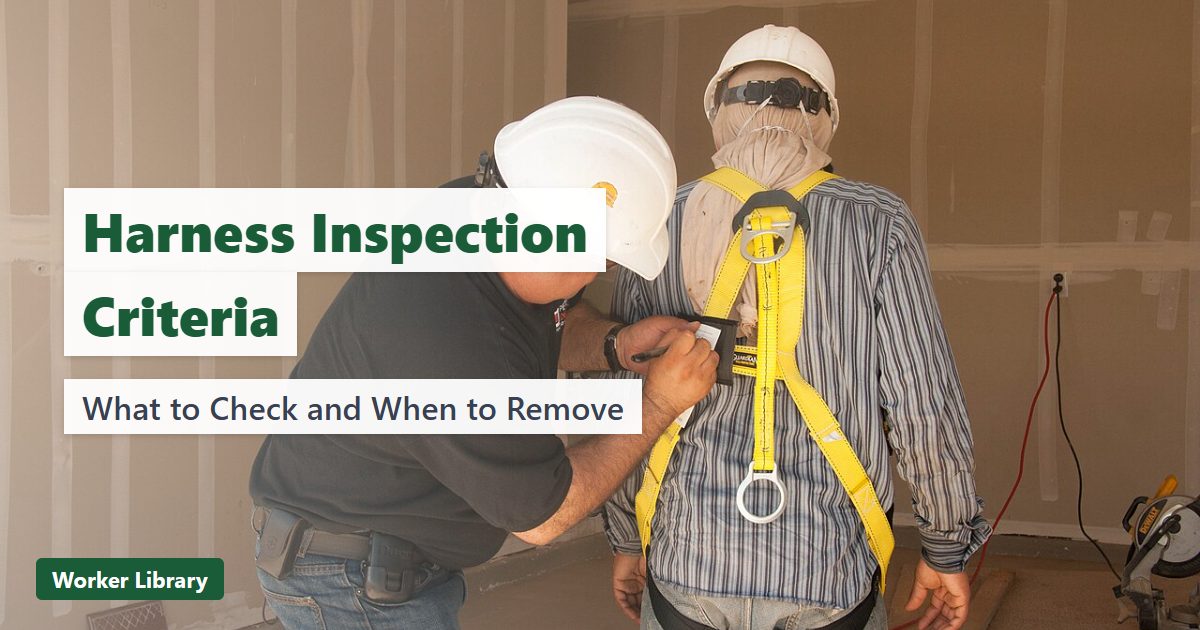
Harness inspection criteria tell you what to look for on a full-body harness and its connectors, and when the gear has to come out of service. This guide covers the OSHA rules, the checks part by part, and how to record them.
- In construction, fall arrest systems are inspected prior to each use (29 CFR 1926.502(d)(21)).
- In general industry, the check is before initial use during each workshift (29 CFR 1910.140(c)(18)).
- The federal criteria are wear, damage, mildew, and other deterioration; a defective component is removed from service.
- Gear that has arrested a fall is normally removed from service, even if it looks undamaged.
Free harness inspection checklist in Excel: one row per harness, lanyard, or SRL, with 7 checks, result, and the date it was removed from service.
Harness inspection criteria are the specific signs of wear, damage, and deterioration that decide whether a fall arrest harness, lanyard, or self-retracting lifeline can be used today. OSHA sets when the inspection happens and what it is for. The manufacturer's instructions set the details for each model. This guide puts both together, part by part, with a way to record the results.
What OSHA says about harness inspection criteria
OSHA states the harness inspection criteria in general terms and leaves the details to the manufacturer. There are two rules, one for construction and one for general industry.
- 29 CFR 1926.502(d)(21) (construction): personal fall arrest systems shall be inspected prior to each use for wear, damage, and other deterioration, and defective components shall be removed from service.
- 29 CFR 1910.140(c)(18) (general industry): personal fall protection systems must be inspected before initial use during each workshift for mildew, wear, damage, and other deterioration, and defective components must be removed from service.
A third rule backs these up for all protective equipment: under 29 CFR 1910.132(e), defective or damaged personal protective equipment shall not be used.
So the federal criteria are: wear, damage, mildew, and other deterioration. If any is found, the component comes out of service. What "wear" looks like on webbing, a D-ring, or a snap hook is spelled out in the manufacturer's instructions and in the checks below. ANSI Z359 is commonly referenced for fall protection equipment, including inspection, but it is not a federal OSHA rule by itself.
When harness inspection criteria apply
Harness inspection criteria are applied at different times depending on the work and on your program. The federal rules set the minimum; many companies add a periodic inspection by a competent person.
| Inspection | When | Who | Record |
|---|---|---|---|
| Pre-use check (construction) | Prior to each use, 1926.502(d)(21) | The worker using the gear | Not required by the federal rule |
| Pre-use check (general industry) | Before initial use during each workshift, 1910.140(c)(18) | The worker using the gear | Not required by the federal rule |
| Periodic inspection | A set schedule in your program and the manufacturer's instructions | A competent person other than the user, in most programs | Equipment ID, date, each check, result, inspector |
| After a fall or damage | Right away | Competent person | Reason removed, date removed |
The difference between the two pre-use rules is small but real. In construction, the check is before each use. In general industry, it is before the first use in each workshift. Many companies simply train workers to check before every use in both settings.
The federal rules do not set an interval for the periodic inspection. ANSI Z359 is commonly referenced for one, and many manufacturers state an interval in their instructions. Your program should name the interval and follow the stricter of the two. Harsh conditions, such as welding, chemicals, or heavy outdoor use, are a reason to inspect more often.
Who inspects a harness
Harness inspection criteria are first applied by the person wearing the harness. The worker checks it before use because they are the one relying on it and because damage can happen any day. Workers need training on what to look for, and that training should use the manufacturer's instructions for the gear they are issued.
A periodic inspection adds a second set of eyes. In most programs it is done by a competent person, someone trained to identify defects and with authority to take gear out of service. This person does not replace the worker's check. They catch slow changes the worker may not notice, such as fading, stiff webbing, or a label that has worn off, and they keep the equipment register up to date.
Write down who holds this role. If harnesses are shared rather than issued to one worker, the periodic inspection is the only time someone looks at the whole set.
Harness inspection criteria for webbing
Harness inspection criteria for webbing get the closest look, because webbing is where cuts, burns, and chemical damage show up. Check the full length of every strap, including parts hidden under pads, keepers, and buckles.
How to check:
- Hold the strap with your hands a few inches apart and bend it into an upside-down U. This opens the surface and shows cuts and broken fibers.
- Work along the whole strap a few inches at a time, front and back.
- Run your fingers along the edges. Damage you can feel is not always visible.
Remove from service if you find:
- Cuts, tears, abrasion, or frayed edges
- Burns, melted spots, or weld spatter marks
- Chemical damage: discoloration, brittle or stiff areas, or a sticky feel
- Mildew or mold
- Heavy fading or stiff, chalky webbing from sun exposure
- Knots, or webbing that is stretched, thinner, or harder than the rest
- Paint or marker over the webbing that hides its condition, unless the manufacturer allows it
Dirt alone is not a reason to remove a harness, but it hides damage. Clean it the way the manufacturer says, then inspect.
Stitching, hardware, and labels
Harness inspection criteria for the rest of the harness are just as specific. A harness with good webbing can still fail at a stitch or a buckle.
Stitching:
- Look for broken, cut, burnt, or pulled stitches, especially at load-bearing joints such as the D-ring and leg strap attachments.
- Many harnesses use thread in a contrasting color so damage is easy to see.
- Some harnesses have a fall indicator: a stitched fold or a tag that tears when the harness has arrested a fall. If it has deployed, remove the harness.
Hardware: D-rings, buckles, adjusters, and grommets:
- Cracks, bends, sharp edges, deep scratches, or distortion
- Corrosion or pitting
- The back D-ring is secure and sits where the manufacturer shows
- Buckles close and hold. Tongue buckles: no bent tongues, and grommets in place and not torn out. Quick-connect buckles: both halves lock and release cleanly
- No hardware that has been modified, welded, or replaced with parts from another brand
Labels:
- The labels are present and legible. They identify the model, the manufacturer, the date of manufacture, and the capacity and warnings for that harness.
- A harness with missing or unreadable labels is commonly removed from service, because no one can confirm its age or rating.
Free harness inspection checklist in Excel: one row per harness, lanyard, or SRL, with 7 checks, result, and the date it was removed from service.
Lanyards, shock absorbers, and self-retracting lifelines
Harness inspection criteria extend to the connectors, because a personal fall arrest system is only as strong as its weakest part. Check each piece every time it is used with the harness.
Lanyards and shock absorbers:
- Webbing or rope lanyards: the same checks as harness webbing, plus no knots, and no unraveling at rope ends
- Shock absorber pack: the cover is intact, and there is no sign that it has started to open or stretch. A deployed or partly deployed shock absorber means the lanyard is removed.
- Snap hooks and carabiners: the gate closes on its own, locks, and does not stick. No cracks, bends, corrosion, or sharp edges. The gate spring is not weak.
Self-retracting lifelines (SRLs):
- The housing has no cracks, missing screws, or damage
- The line pulls out smoothly and retracts fully
- A sharp tug locks the line, and it releases when the tension comes off
- The line or cable has no cuts, kinks, broken strands, or corrosion
- The impact indicator, if the unit has one, has not been activated
- The service date is within the manufacturer's interval, if the manufacturer requires factory service
If your crews work from aerial lifts or scaffolds, the anchor point and the equipment they tie off to are inspected too; see the aerial lift inspection checklist and the scaffold inspection checklist.
Pass or remove: harness inspection criteria for removing gear
Harness inspection criteria lead to one of two outcomes under the OSHA rules: the gear is used, or the defective component is removed from service. There is no "use it carefully" result for a defect.
Remove from service right away when:
- Any check above fails
- The harness, lanyard, or SRL has arrested a fall, even if it looks fine. Webbing can stretch and shock absorbers can deploy without obvious signs. Follow the manufacturer's instructions; most say the equipment is removed or returned to them.
- The labels are missing and the age or rating cannot be confirmed
- The equipment is past the service life the manufacturer gives
Mark removed equipment clearly, take it out of the gear room, and destroy it or return it as your program says, so it does not drift back into use. A tag that says "Do Not Use" and the date is a good start; cutting the webbing of a harness that is being thrown away is common practice.
Some programs use a "watch" result for gear that passes today but is getting old or showing light wear. That is a planning tool, not a third option for a defect. It tells the safety manager to order a replacement before the next periodic inspection.
How long a harness lasts is set by the manufacturer, not by federal OSHA. Check the instructions and the label for your model. Age is a reason to look harder; damage is a reason to remove at any age.
Recording harness inspections
Harness inspection criteria are only useful over time if someone writes down the results. The federal rules ask for the inspection and the removal of defective components; they do not say the pre-use check must be written down. Many companies record the periodic inspection, because it is the only way to track each harness's age, condition, and history.
A useful register has one row per item:
- Equipment ID, type, make and model, and who it is assigned to
- Manufacture month and in-service month
- Inspection date and a Pass, Fail, or N/A for each check
- Result: OK to use, watch, or remove from service
- Reason removed, date removed, and the inspector's name
The Harness Inspection Checklist is set up this way. It lists each full-body harness, lanyard, and SRL on its own row, with seven checks (webbing, stitching, hardware, lanyard or rope, shock absorber, retractor, labels and impact indicator), a result, and the reason and date if the item was removed. It is a way to record the inspections; it is not an official OSHA form, and it does not replace the worker's own check before use. If you also track hard hats, gloves, or respirators, the PPE inspection checklist covers those.
How long to keep the records is not set by the federal fall protection rules. Common practice is to keep the record for as long as the equipment is in service, plus a period your program sets after it is removed. State plans, such as California and Washington, may add their own requirements.
Free harness inspection checklist in Excel: one row per harness, lanyard, or SRL, with 7 checks, result, and the date it was removed from service.
Harness inspection criteria FAQ
Harness inspection criteria raise the same few questions in most safety programs.
How often should a harness be inspected?
Under 29 CFR 1926.502(d)(21), a personal fall arrest system in construction is inspected prior to each use. In general industry, 29 CFR 1910.140(c)(18) says before initial use during each workshift. Most programs also have a competent person inspect each harness on a set schedule, using the manufacturer's instructions; ANSI Z359 is commonly referenced for that interval.
What are the most common reasons a harness fails inspection?
Webbing damage is a frequent reason: cuts, frayed edges, burns, chemical damage, and fading from the sun. Broken stitching, bent or corroded hardware, a deployed fall indicator, and missing labels are the other usual reasons.
Can a harness be used after a fall?
Equipment that has arrested a fall is normally removed from service, even if it looks undamaged. Follow the manufacturer's instructions for that model.
How long is a fall protection harness good for?
Federal OSHA does not set a service life. The manufacturer does, so check the instructions and the label. A harness with any defect is removed regardless of its age.
Does the pre-use check need to be written down?
The federal rules ask for the inspection, not a written record of the pre-use check. Many companies record the periodic competent person inspection in a register, and some also use a sign-off for pre-use checks. Follow your company program.
Check the current rules at the links above and the manufacturer's instructions for each harness, lanyard, and lifeline. This guide describes what the federal rules ask for; it is not legal advice.
Free harness inspection checklist in Excel: one row per harness, lanyard, or SRL, with 7 checks, result, and the date it was removed from service.
Related guides
More in Construction Safety
Popular templates
- Forklift Inspection ChecklistForklifts & Vehicles
- Preventive Maintenance ChecklistEquipment & Maintenance
- Daily Equipment Inspection ChecklistEquipment & Maintenance
- Construction Site Safety ChecklistConstruction Safety
- Scaffold Inspection ChecklistConstruction Safety
- Vehicle Inspection ChecklistForklifts & Vehicles
- Fire Extinguisher Inspection LogWorkplace Safety
Categories
Latest guides
- Ladder Inspection Requirements: OSHA Rules and What to Check
- OSHA Crane Inspection Requirements: Shift, Frequent and Periodic Checks
- Scaffold Inspection Requirements: When, Who, and What to Check
- Forklift LOLER Inspection: Thorough Examination Intervals and Records
- OSHA Forklift Inspection Requirements: Daily Checks and Records
- Fire Extinguisher Inspection Requirements: Monthly and Annual