

OSHA Crane Inspection Requirements: Shift, Frequent and Periodic Checks
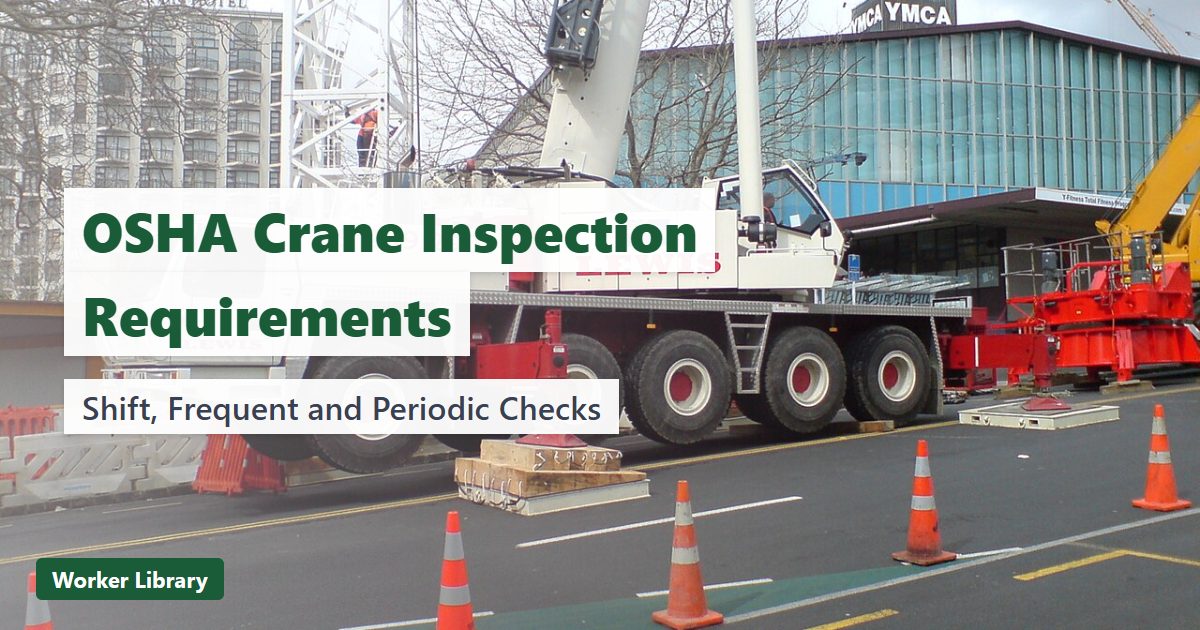
OSHA crane inspection requirements depend on the crane and the work. Overhead and gantry cranes in general industry have frequent and periodic inspections; cranes used in construction get a visual check by a competent person before each shift. This guide sets out what the rules say and how to keep a record that shows the checks were done.
- Overhead and gantry crane inspections are frequent (daily to monthly) or periodic (1 to 12 months) under 29 CFR 1910.179(j)(1)(ii).
- In construction, a competent person begins a visual inspection before each shift the crane is used (29 CFR 1926.1412(d)(1)).
- Slings and rigging used with the crane are inspected each day before use by a competent person (29 CFR 1910.184(d)).
- A dated, signed record is the practical way to show each check happened; State Plans may add their own rules.
Free crane inspection checklist in Excel: a daily pre-shift check for overhead cranes, a 32-item monthly check, a periodic record, and a mobile crane sheet.
OSHA crane inspection requirements are not one rule but a few, and which one applies depends on the crane type and whether the work is general industry or construction. Many pages online merge them into one list with fixed intervals. Below is what the cited federal paragraphs actually say, what most employers add on top, and a simple way to record each check.
This guide covers federal OSHA only. States that run their own State Plans approved by OSHA, such as California and Washington, can add requirements, and some states and cities license crane inspectors. It is general information, not legal advice.
What OSHA crane inspection requirements cover
OSHA crane inspection requirements sit in two parts of Title 29. General industry overhead and gantry cranes fall under 29 CFR 1910.179, and cranes used in construction fall under Subpart CC of Part 1926. The two rules use different words and different triggers, so start by deciding which one your crane falls under.
- General industry covers plants, warehouses, steel service centers, and shops with a top-running bridge crane, a gantry crane, or a similar fixed crane.
- Construction covers cranes doing construction work, such as a truck crane, rough-terrain crane, crawler crane, or tower crane on a building site.
Crawler, locomotive, and truck cranes used in general industry (not construction) have their own section in Part 1910. This guide does not cover that section, so read it directly if it applies to you.
Behind every specific rule sits the OSH Act General Duty Clause, Section 5(a)(1): each employer furnishes a place of employment free from recognized hazards that are causing or likely to cause death or serious physical harm. A dropped load is one of those hazards, which is why crane inspections are taken seriously even where a rule says little about format.
OSHA crane inspection requirements for overhead and gantry cranes
For overhead and gantry cranes, the OSHA crane inspection requirements start with 29 CFR 1910.179(j)(1)(ii). The paragraph divides inspections into two classes: frequent inspection at daily to monthly intervals, and periodic inspection at 1 to 12 month intervals.
The rule gives a range, not one number, because cranes differ so much in use. A crane that makes hundreds of lifts a day in a steel mill wears faster than a maintenance crane in a pump house that lifts a motor twice a year. Where in the range your crane falls depends on its service, its environment, and the manufacturer's instructions.
In practice, most plants run it like this:
- A short pre-shift check by the operator before the first lift, covering functions and obvious damage.
- A documented frequent inspection at the interval the employer sets inside the daily to monthly range, often monthly.
- A periodic inspection by a qualified inspector or service company at the interval set inside the 1 to 12 month range, often yearly, sometimes with a load test.
The rest of section 1910.179 lists what each class looks at and has further paragraphs on tests and records. This guide cites only the paragraph that sets the two classes, so read the current section for the full lists.
OSHA crane inspection requirements in construction
On a construction site, the OSHA crane inspection requirements start with 29 CFR 1926.1412(d)(1). A competent person must begin a visual inspection prior to each shift the equipment will be used, and complete it before or during that shift.
Three words in that sentence matter:
- Competent person. The person doing the shift check must be able to spot hazards and have the authority to act on them. Often this is the operator, but it does not have to be.
- Each shift. If the crane runs on two shifts, it gets two checks. If it sits idle for a shift, no check is needed for that shift.
- Begin before, complete during. Some items, such as a function check of the anti-two-block device, can only be confirmed once the crane is running. The rule allows the check to be finished during the shift, but most crews finish it before the first lift.
Section 1926.1412 has more paragraphs than (d)(1), covering other inspection types. This guide relies only on the shift inspection paragraph, so check the current text for the rest.
| Crane and setting | Rule cited here | Interval | Who usually does it | Common record |
|---|---|---|---|---|
| Overhead or gantry crane, general industry | 29 CFR 1910.179(j)(1)(ii) | Frequent: daily to monthly | Operator for pre-shift; trained maintenance person for frequent | Monthly grid with daily initials, frequent inspection sheet |
| Overhead or gantry crane, general industry | 29 CFR 1910.179(j)(1)(ii) | Periodic: 1 to 12 months | Qualified inspector or service company | Inspector's report, date, findings, next due date |
| Crane used in construction | 29 CFR 1926.1412(d)(1) | Each shift the crane is used | Competent person | Shift checklist with name, date, findings |
| Slings and rigging used with any crane | 29 CFR 1910.184(d) | Each day before use | Competent person designated by the employer | One line per sling: damage checks, result |
Who does each crane inspection
The question of who does each crane inspection has a different answer for each class. For construction cranes, the shift inspection is done by a competent person, which is spelled out in 1926.1412(d)(1). For overhead cranes, the paragraph cited here sets the classes but not the job title, so the employer decides and writes it down.
A common split that works for most sites:
- Operator: pre-shift function and visual check, every shift the crane is used.
- Trained maintenance person: the frequent inspection, with a sign-off.
- Qualified inspector or crane service company: the periodic inspection and any load test.
- Supervisor: confirms the checks happened, receives defect reports, and decides when a tagged-out crane returns to service.
Rigging deserves its own line. Under 29 CFR 1910.184(d), each day before use, slings and all fastenings and attachments are inspected for damage or defects by a competent person designated by the employer. If the operator is not that person, name who is.
What a crane inspection checks in practice
A crane inspection checks the parts that hold, move, and stop the load. The manufacturer's manual for each crane is the first source for items and limits, and the ASME B30 series is commonly referenced for inspection items and removal criteria. Neither is the federal rule itself.
A typical pre-shift check on an overhead crane, done with no load on the hook:
- Upper limit switch stops the hook block before it reaches the drum
- Hoist, bridge, and trolley brakes stop and hold
- Pendant buttons work and return to off; labels readable
- Wire rope seated in sheaves and drum grooves; no visible broken wires, kinks, or crushing
- Hook not cracked or bent; safety latch closes
- Warning horn and emergency stop work
- No lockout or "Out of Service" tag on the crane or its disconnect
A frequent inspection goes deeper: brake lining wear, rope end fittings, sheave grooves, hook throat opening, wiring and collectors, end stops, and the structure. A mobile crane shift check adds the engine, outriggers, boom, and safety devices such as the anti-two-block and load moment indicator.
Free crane inspection checklist in Excel: a daily pre-shift check for overhead cranes, a 32-item monthly check, a periodic record, and a mobile crane sheet.
OSHA crane inspection requirements when a defect is found
OSHA crane inspection requirements are only useful if a finding stops the lift. A crane with a defect that affects safe lifting should not make another lift until it is repaired and a named person returns it to service. The General Duty Clause and the specific crane rules both point in that direction, and an inspector reviewing an incident will ask what happened after the defect was written down.
A routine that holds up:
- Stop. Lower any load and park the hook.
- Tag the crane out at the pendant and the disconnect.
- Write the defect on the checklist: what, where, when, who found it.
- Tell the supervisor and maintenance.
- Repair, then record who checked the repair and returned the crane to service.
If inspections are skipped, the risk is not only a citation. A missed broken wire or a worn brake can drop a load, and after an incident the first document anyone asks for is the inspection record. Decide in advance which items are "no lift" items, such as limit switch, brakes, hook latch, and wire rope damage.
OSHA crane inspection requirements for records
OSHA crane inspection requirements are easier to show than to describe. A dated record with a name on it is the practical way to prove a check happened before the lift. The paragraphs cited in this guide set inspection classes and the shift check; read the current text of 1910.179 and 1926.1412 for what each one says about written records and how long to keep them.
What most employers keep:
- Pre-shift checks: one sheet per crane per month, with daily initials.
- Frequent inspections: one signed sheet per inspection, with findings and repairs.
- Periodic inspections: the inspector's report, a summary line in the crane file, and the next due date.
- Repairs: what was done, by whom, and who returned the crane to service, kept for the life of the crane.
State Plans, insurers, and general contractors often ask for more, so check theirs before you set a retention period.
How the template records each inspection
A crane inspection record works best when each class of inspection has its own sheet in one file per crane. The Crane Inspection Checklist is set up that way. It is a way to record the checks, not an official OSHA form.
- Daily Pre-Shift: 10 checks for an overhead or gantry crane (4 function checks with no load and 6 visual checks), one column per day, operator and rigger initials, and a defect record.
- Frequent Inspection (Monthly): 32 components in 8 groups with what to check and how, plus sign-off lines.
- Periodic Inspection Record: date, inspector or company, load test, result, defects, repairs, report number, and next due date.
- Mobile Crane Pre-Shift: 66 items in 13 groups for truck, rough-terrain, all-terrain, and crawler cranes.
Keep slings on their own log with the rigging inspection checklist, one line per sling or shackle. For general repair history, an equipment maintenance log sits well beside the crane file.
Free crane inspection checklist in Excel: a daily pre-shift check for overhead cranes, a 32-item monthly check, a periodic record, and a mobile crane sheet.
OSHA crane inspection requirements FAQ
These are the questions about OSHA crane inspection requirements that come up most often.
How often does OSHA require a crane inspection?
For overhead and gantry cranes, 29 CFR 1910.179(j)(1)(ii) sets frequent inspections at daily to monthly intervals and periodic inspections at 1 to 12 month intervals. For cranes in construction, a competent person begins a visual inspection before each shift the crane is used.
Does OSHA require an annual crane inspection?
The general industry paragraph gives a 1 to 12 month range for periodic inspections, not a fixed annual date. Many employers choose yearly as the outer limit of that range, and some state or city rules set their own schedule.
Who can inspect a crane under OSHA?
For the construction shift inspection, a competent person. For overhead cranes, the employer names who does each class; periodic inspections are usually done by a qualified inspector or crane service company.
Do slings need a separate inspection?
Yes. Under 29 CFR 1910.184(d), slings and their fastenings and attachments are inspected each day before use by a competent person designated by the employer.
Is a crane checklist an OSHA form?
No. OSHA does not publish a standard crane checklist. Use the manufacturer's manual, the current rule text, and a form that fits your cranes.
Check the current rule at the links above, your State Plan, and your crane manufacturer's instructions. This guide describes what the cited federal rules ask for; it is not legal advice.
Free crane inspection checklist in Excel: a daily pre-shift check for overhead cranes, a 32-item monthly check, a periodic record, and a mobile crane sheet.
More in Construction Safety
Popular templates
- Forklift Inspection ChecklistForklifts & Vehicles
- Preventive Maintenance ChecklistEquipment & Maintenance
- Daily Equipment Inspection ChecklistEquipment & Maintenance
- Construction Site Safety ChecklistConstruction Safety
- Scaffold Inspection ChecklistConstruction Safety
- Vehicle Inspection ChecklistForklifts & Vehicles
- Fire Extinguisher Inspection LogWorkplace Safety