

OSHA Power Tool Inspection Requirements on Construction Sites
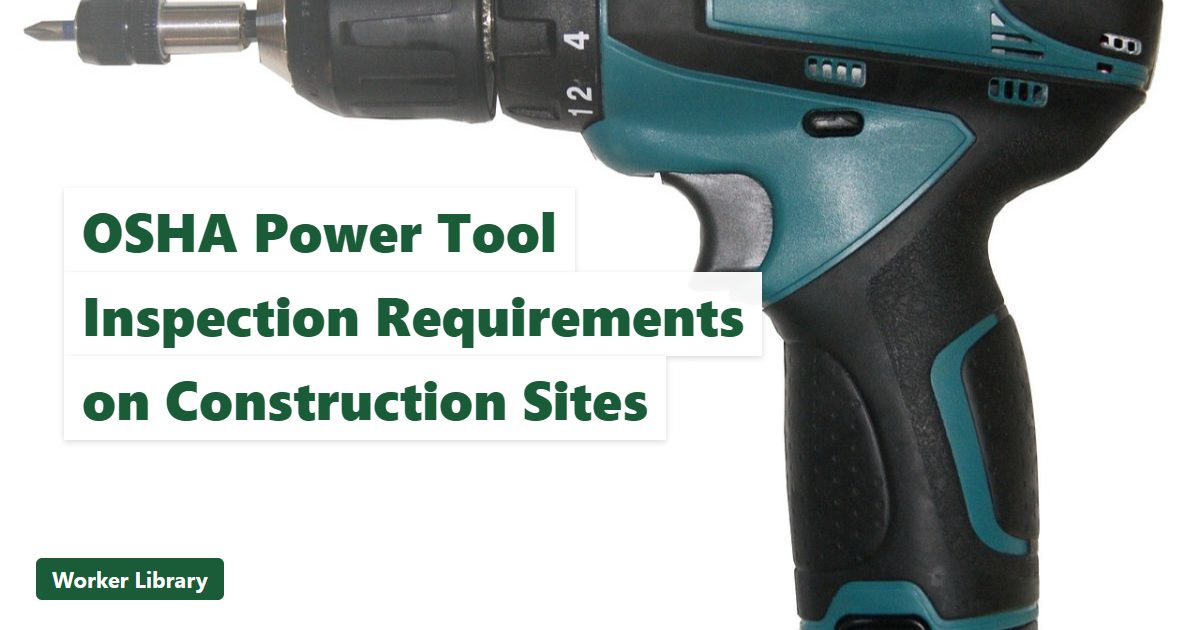
OSHA power tool inspection requirements on construction sites start with 29 CFR 1926.300(a): all hand and power tools and similar equipment are maintained in a safe condition, whether the employer or the employee owns them. The rule sets no inspection interval, so the check is up to the employer. This guide explains what that means and how to keep a simple daily record.
- 29 CFR 1926.300(a): all hand and power tools and similar equipment are maintained in a safe condition.
- The rule covers tools furnished by the employer or the employee, so personal tools on site count too.
- OSHA sets no fixed interval for power tool checks; a check before first use each day is common practice.
- Construction safety programs provide for frequent and regular equipment inspections by competent persons (1926.20(b)(2)).
Free power tool inspection checklist in Excel: 27 pre-use checks for power tools, electrical equipment, welders, and PPE on a 31-day grid, with a defect record.
OSHA power tool inspection requirements are one of the most searched safety topics on construction sites, and one of the most misread. People look for a federal inspection interval and a federal checklist. Neither exists for hand and power tools in general. What exists is a short rule about condition, a general rule about inspections in construction safety programs, and a lot of practice built around them. This guide sets out the cited federal text first, then the practice, then a simple way to record it.
This guide covers federal OSHA in construction. General industry has its own subpart for hand and portable powered tools, and States that run their own State Plans approved by OSHA, such as California and Washington, can add requirements. It is general information, not legal advice.
What OSHA power tool inspection requirements say
OSHA power tool inspection requirements in construction start with 29 CFR 1926.300(a). All hand and power tools and similar equipment, whether furnished by the employer or the employee, shall be maintained in a safe condition. That is the whole of paragraph (a).
Three things follow from that sentence:
- Condition, not paperwork. The rule is about the tool being safe, not about a form. A record helps you show the tool was safe, but the duty is the condition itself.
- Every tool on site. Tools the worker brings from home are covered just as much as tools from the company trailer.
- No interval. The paragraph does not say daily, weekly or quarterly. The employer decides how to keep tools in a safe condition, and most do it with a check before use.
The rest of section 1926.300 covers guarding and other topics, and construction has separate electrical rules that also apply to corded tools and cords. This guide relies on paragraph (a) only, so read the current text for the rest.
OSHA power tool inspection requirements and the construction safety program
OSHA power tool inspection requirements get their "who" from the general construction rules. The rule is 29 CFR 1926.20(b)(2). Safety programs provide for frequent and regular inspections of the job sites, materials and equipment by competent persons designated by the employer. Power tools are equipment, so they belong in that program.
The paragraph does not say how frequent or what form. In practice, sites cover it in layers:
- the tool user checks the tool before using it;
- a competent person (often the foreman or a designated electrician) checks tools and cords on a regular schedule and walks the site;
- the tool room or crib checks tools when they come back and before they go out again.
Behind both rules sits the OSH Act General Duty Clause, Section 5(a)(1): each employer furnishes a place of employment free from recognized hazards that are causing or likely to cause death or serious physical harm. A cracked grinding wheel or a cord with exposed conductors is a recognized hazard.
How often OSHA power tool inspection requirements expect a check
OSHA power tool inspection requirements set no number of days or months. Because the rule is "maintained in a safe condition", the practical answer is a quick check before the first use each day, plus a deeper periodic check by a competent person.
| Check | Federal rule cited here | Interval | Who usually does it | Common record |
|---|---|---|---|---|
| Pre-use check of each tool | 1926.300(a) (safe condition) | Before first use each day (common practice) | Tool user | Daily initials on a monthly sheet |
| Site inspection of tools, cords and equipment | 1926.20(b)(2) | Frequent and regular; employer sets it | Competent person designated by the employer | Inspection sheet with name and date |
| Periodic tool and cord check with a color code | Electrical rules in Part 1926; check the current text | Set by the rule or the site | Competent person or electrician | Color code record, test results |
| Insulating PPE for electrical work | Rule and standard for that work | Their own test intervals | Qualified person | Test dates |
| Defective tool | 1926.300(a); 1910.132(e) for damaged PPE | Whenever found | Anyone stops; supervisor decides | Defect record, repair, return to service |
Many sites use a periodic color code: a colored tape on each tool and cord that shows it passed the check for the current period. That practice is often tied to the electrical rules for cord sets and receptacles. Those paragraphs are not in the verified list for this guide, so check the current text if you rely on them.
What a power tool inspection checks
OSHA power tool inspection requirements do not list check items, so the manufacturer's manual is the first source. A good pre-use check looks at the cord and plug, the housing, the switch, the guards and the accessory, in that order, before the tool is plugged in.
Common items for corded and cordless power tools:
- Cord and plug: no cuts, crushed spots, taped repairs or exposed wires; ground pin present, or the tool is marked double insulated.
- Housing: no cracks, loose screws or missing parts; no unusual noise, smell or heat once running.
- Switch: works and returns to off; the lock-on button is not stuck.
- Guards: in place and moving freely, especially the lower guard on a circular saw.
- Accessories: grinding wheels free of cracks and rated for the tool speed, saw blades sharp with no missing teeth.
- GFCI: trips when the test button is pressed, where one is used.
Welding equipment, insulating gloves and live-line tools have their own checks. Manufacturer instructions and commonly referenced ANSI standards set those details; they are not part of the federal paragraph cited here.
OSHA power tool inspection requirements when a tool is defective
OSHA power tool inspection requirements leave no room for a tool that is not in a safe condition. A tool that fails a check is taken out of service right away, not used until the end of the shift. Writing the defect down is not enough on its own.
A routine that holds up:
- Unplug the tool or remove the battery.
- Tag it "Do Not Use" and move it out of the work area.
- Write the defect on the sheet: which tool, what was wrong, who found it and when.
- Repair it with the right parts, or replace it.
- Record who checked the repair and put the tool back in service.
The same goes for protective equipment used with tools. Under 29 CFR 1910.132(e), defective or damaged personal protective equipment shall not be used. A cracked face shield or torn insulating glove is pulled just like a tool. For more on PPE checks, see OSHA PPE inspection requirements.
Free power tool inspection checklist in Excel: 27 pre-use checks for power tools, electrical equipment, welders, and PPE on a 31-day grid, with a defect record.
OSHA power tool inspection requirements for records
OSHA power tool inspection requirements in 1926.300(a) do not ask for a written record. A dated sheet with initials is still the plain way to show that tools were checked and that a defective tool was taken out of use. General contractors, owners and insurers often ask for it, especially after an incident.
What most crews keep:
- one sheet per job site or work area per month, with daily initials;
- a defect record that shows what happened after a tool failed;
- the periodic color code record, if the site uses one; and
- repair and replacement notes for expensive tools.
There is no federal retention period in the paragraph cited here. Many contractors keep the sheets for the length of the project, or longer if their insurer asks.
How the template records power tool checks
OSHA power tool inspection requirements are easiest to show with one monthly sheet per job site or work area. The template has 27 checks in 4 groups, a column for each day, initials for the inspector and the tool user, and a defect record. It is a way to record checks, not an official OSHA form.
The Power Tool Inspection Checklist groups the checks like this:
- Electrical equipment (12 checks): electrode holders, welder voltage-reducing device, GFCI, grounded tools, extension cords, voltage testers, grounding sets, insulating gloves, blankets, aerial devices, hot sticks and guards. Keep only the rows for equipment you use.
- Power tools (8 checks): cord and plug, ground pin or double insulation, housing, switch, guards, grinding wheels, circular saws and the color code.
- Arc and gas welding (4 checks): leads and clamp, the VRD test, grounding and damp locations, and fire prevention with a hot work permit if required.
- PPE and work area (3 checks): insulating PPE and eye protection, ventilation and dust control, and cord routing.
Mark each item with a check, an X or N/A. Any X means the tool comes out of service and goes on the defect record. For machines that stay in one place, the daily equipment inspection checklist fits better, and repairs can go on the equipment maintenance log.

OSHA power tool inspection requirements FAQ
These are the questions about OSHA power tool inspection requirements that come up most often.
How often does OSHA require power tools to be inspected?
The cited rule, 29 CFR 1926.300(a), sets no interval. It asks that tools be maintained in a safe condition. A check before first use each day is common practice, plus regular inspections by a competent person under 1926.20(b)(2).
Do OSHA rules cover tools that workers bring from home?
Yes. Paragraph (a) covers tools furnished by the employer or the employee.
Does OSHA require a written power tool inspection record?
Not in the paragraph cited here. A dated sheet with initials is the clearest proof, and many general contractors require one.
Is there an OSHA power tool inspection checklist?
No. OSHA does not publish a standard checklist. Build one from the manufacturer's manual, the current rule and the tools your crew actually uses.
Check the current rule at the links above, your State Plan, and your tool manufacturer's instructions. This guide describes what the cited federal rules ask for; it is not legal advice.
Free power tool inspection checklist in Excel: 27 pre-use checks for power tools, electrical equipment, welders, and PPE on a 31-day grid, with a defect record.
Related guides

More in Equipment & Maintenance
Popular templates
- Forklift Inspection ChecklistForklifts & Vehicles
- Preventive Maintenance ChecklistEquipment & Maintenance
- Daily Equipment Inspection ChecklistEquipment & Maintenance
- Construction Site Safety ChecklistConstruction Safety
- Scaffold Inspection ChecklistConstruction Safety
- Vehicle Inspection ChecklistForklifts & Vehicles
- Fire Extinguisher Inspection LogWorkplace Safety
Categories
Latest guides
- How to Create a Preventive Maintenance Checklist (Free Template)
- OSHA Job Site Inspection Requirements: Who, How Often, Records
- OSHA PPE Inspection Requirements: What the Rules Say and How to Record
- OSHA Sling Inspection Requirements: Daily Checks, Who and Records
- Fire Extinguisher Inspection Requirements UK: The Law, Checks and Servicing
- Aerial Lift Inspection Requirements: Daily, Frequent, and Annual
- Harness Inspection Criteria: What to Check and When to Remove
- Ladder Inspection Requirements: OSHA Rules and What to Check
- OSHA Crane Inspection Requirements: Shift, Frequent and Periodic Checks
- Scaffold Inspection Requirements: When, Who, and What to Check
- Forklift LOLER Inspection: Thorough Examination Intervals and Records
- OSHA Forklift Inspection Requirements: Daily Checks and Records
- Fire Extinguisher Inspection Requirements: Monthly and Annual